 TONELOUPE
False color, explained
A waveform tells you everything about exposure, if you're willing to stop, look away from the image, and decode a graph. False color skips the decoding: it paints the answer directly onto the picture. Here's how it works and why cinematographers swear by it.
 ToneLoupe puts exposure + skin false color over any Mac
app, no monitor needed. Free 7-day trial →
ToneLoupe puts exposure + skin false color over any Mac
app, no monitor needed. Free 7-day trial →
The idea
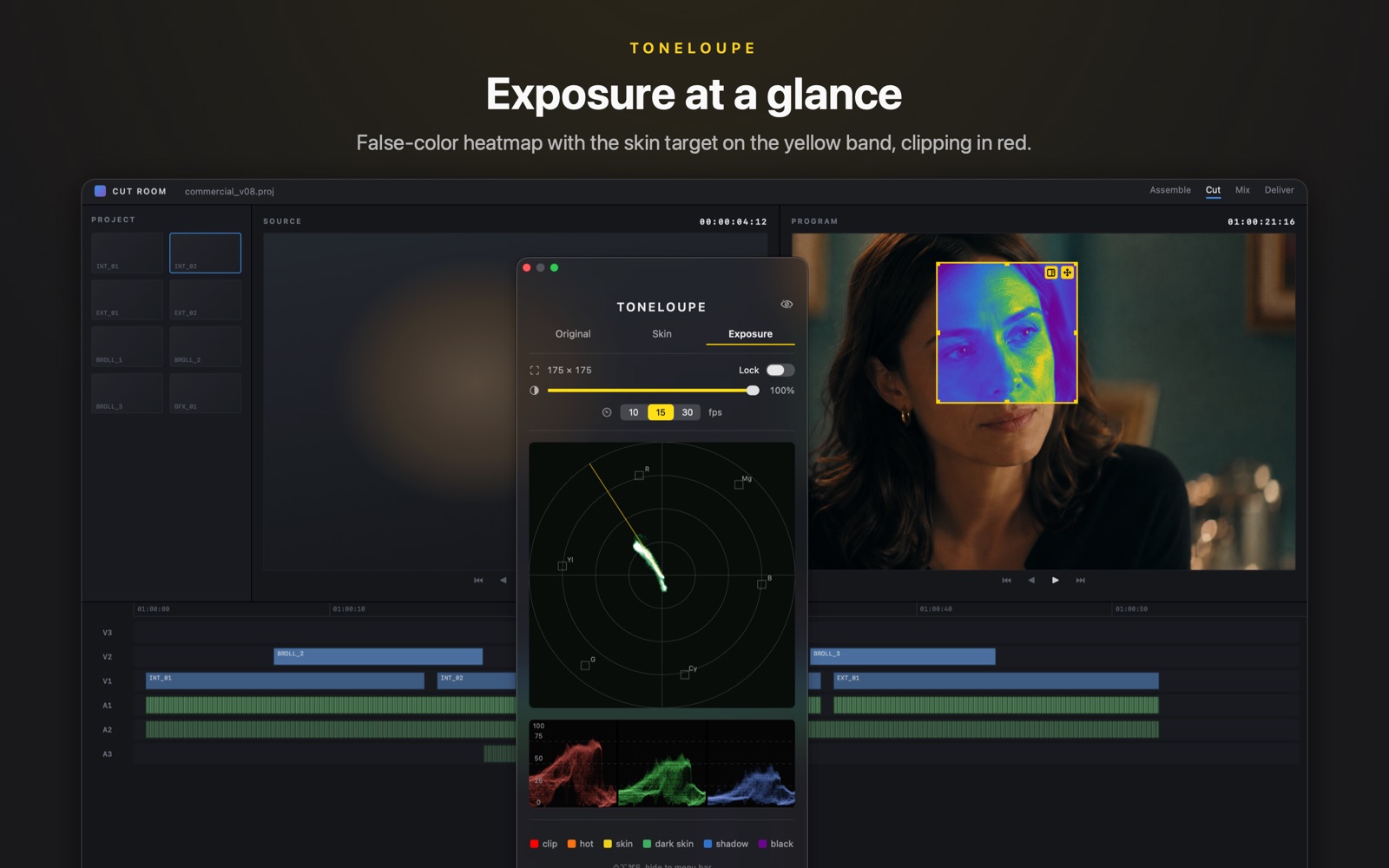
False color remaps every pixel's luminance to a fixed color scale: crushed shadows in purple/blue, mids in green and gray, the skin-exposure zone in pink or yellow, clipped highlights in red. One glance at the frame tells you what's blown, what's buried and where the face sits, spatially and on the image itself, which is the one thing a waveform can't do.
That's why it lives on set: ARRI and RED build it into cameras, SmallHD and Atomos into monitors. A DP pulling exposure doesn't read graphs mid-take; they watch for the face to hold its band.
Reading the bands
Exact colors vary by vendor (learn your tool's legend once), but the logic is universal:
- Red. Clipped. No detail, nothing to recover.
- Yellow/orange. Just under clipping; highlights with detail, bright skin accents.
- Pink. On many scales, the classic caucasian skin-exposure band (~55–70 IRE); the band a DP rides the key light against. More on the numbers in What IRE should skin be?
- Green/gray. Comfortable midtones.
- Blue/purple. Deep shadows heading to crush.
The other false color: hue, not luminance
Exposure false color answers "how bright is the skin?" A second, rarer variant answers "is the skin the right color?" It evaluates each pixel's hue against the vectorscope skin-tone line (explained here) and marks on-line skin one color, drift toward green or magenta another. It turns the subtlest grading error, a hue cast on a face, into something you can't not see. This is the mode ToneLoupe is built around: yellow on the line, green or pink off it, painted on the face while you grade.
Using false color without a dedicated monitor
In post you have three options. Resolve ships a false color effect and third-party plugins exist for most NLEs, but only inside that NLE. Dedicated scope hardware works, for a four-figure price and a signal chain. Or a screen-level tool: ToneLoupe reads any pixels on your Mac's display, so the same exposure heatmap and skin-line false color work over your NLE, Lightroom, a browser review page, or footage playing anywhere, with no routing and no plugins per app.
Skin-line false color and an exposure heatmap on the image itself, plus a live vectorscope and RGB parade, anywhere on your screen.